

Digital Marketing vs Content Marketing: What’s the Difference?
Introduction
If you run a business, manage a brand, or market services online, you have likely heard the terms digital marketing and content marketing used interchangeably. Many assume they are the same. They are not.
Understanding Digital Marketing vs Content Marketing is crucial for building a sustainable online presence, generating leads, and driving long-term growth. At Text & Arts Solutions, we often see businesses investing heavily in ads without content—or producing content without a clear distribution strategy. Both approaches limit results.
This blog breaks down the difference between digital marketing and content marketing, explains how each works, and shows how they perform best when used together.
What Is Digital Marketing?
Digital marketing refers to all marketing efforts that use digital channels to promote products or services. Its primary goal is visibility, reach, and conversions using online platforms.
When people ask what is digital marketing, the simplest answer is this:
It is how brands attract, engage, and convert customers through the internet.
Digital marketing focuses on distribution, promotion, targeting, and performance tracking.
How Digital Marketing Works
To understand how digital marketing works, think of it as a system:
- Identify your target audience
- Choose the right digital marketing channels
- Create promotional assets (ads, landing pages, emails)
- Drive traffic
- Track performance and optimize
A strong digital marketing strategy is data-driven. It relies on analytics, A/B testing, audience segmentation, and continuous optimization to achieve results.
Digital Marketing Channels
Some of the most common digital marketing channels include:
- Search Engine Marketing (Google Ads, Bing Ads)
- Social Media Advertising (Meta, LinkedIn, YouTube)
- Email Marketing
- Affiliate Marketing
- Influencer Marketing
- Display and Retargeting Ads
Businesses often partner with a digital marketing agency or opt for best digital marketing services in India to manage these channels efficiently.
Benefits of Digital Marketing
Key benefits of digital marketing include:
- Instant visibility
- Highly targeted campaigns
- Measurable ROI
- Scalability
- Faster lead generation
Digital marketing works exceptionally well when quick results are required—such as product launches, seasonal campaigns, or sales promotions.
What Is Content Marketing?
Now let’s address the other side of Digital Marketing vs Content Marketing.
Content marketing focuses on creating valuable, relevant, and consistent content to attract and retain a clearly defined audience.
If digital marketing is about promotion, content marketing is about connection.
When people ask what is content marketing, the answer lies in trust-building rather than selling.
Also Read: Top 5 Content Marketing Agency in India 2026
Content Marketing Explained
Content marketing explained simply:
You educate before you sell.
A strong content marketing strategy involves understanding user intent, pain points, and search behavior. The content answers questions, solves problems, and builds authority over time.
This is why businesses increasingly rely on a content marketing agency or the best content marketing agency in India for long-term growth.
Content Marketing Examples
Some effective content marketing examples include:
- SEO blogs and articles
- Website copy and landing pages
- Social media content
- Video scripts and YouTube content
- Case studies and whitepapers
- Email newsletters
- Brand storytelling
At Text & Arts, our content marketing services combine research, psychology, and language expertise to ensure content feels human—not machine-generated.
Benefits of Content Marketing
The core benefits of content marketing are:
- Long-term organic traffic
- Higher brand credibility
- Better audience engagement
- Lower cost per lead over time
- Strong SEO foundation
Unlike ads, content keeps working even when the campaign stops.
Difference Between Digital Marketing and Content Marketing
Here is the simplest way to understand the difference between digital marketing and content marketing:
- Digital marketing promotes
- Content marketing educates
- Digital marketing focuses on reach
- Content marketing focuses on relationship
- Digital marketing is often paid
- Content marketing is primarily organic
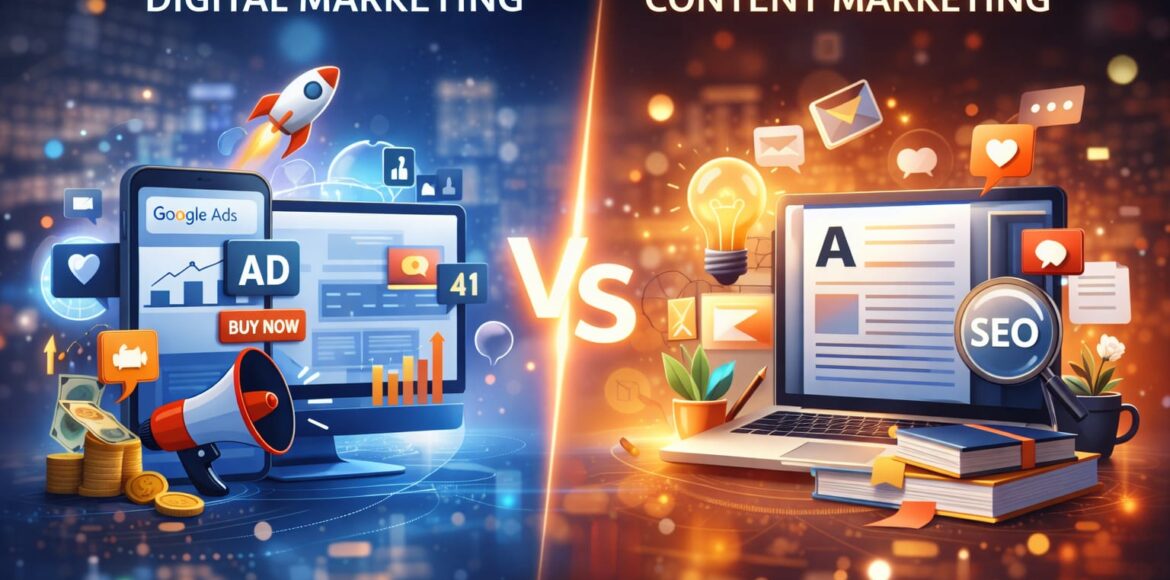
This distinction is why the debate around Digital Marketing vs Content Marketing is not about choosing one—but about balance.
Digital Marketing vs Content Marketing: Which One Should You Choose?
The answer depends on your goals:
- Want immediate leads? → Digital marketing services
- Want long-term brand authority? → Content marketing services
- Want sustainable growth? → Both
Smart brands do not ask which is better. They ask how to integrate both effectively.
Role of SEO in Digital and Content Marketing
SEO and content marketing are inseparable.
Content fuels SEO, while digital marketing amplifies it. Blogs, landing pages, and website copy help rank organically, while paid ads help test keywords and messaging quickly.
This synergy is why a strong SEO-focused content strategy outperforms ad-only campaigns in the long run.
How Digital Marketing and Content Marketing Work Together
The most effective brands use content to attract and digital marketing to distribute.
For example:
- Blogs bring organic traffic
- Ads retarget engaged readers
- Email marketing nurtures leads
- Content builds trust before conversion
At Text & Arts Solutions, we design integrated strategies where content and promotion work as one—not in silos.
Conclusion
The debate around Digital Marketing vs Content Marketing misses the bigger picture. One drives visibility. The other builds credibility.
Businesses that rely only on ads burn budgets. Businesses that rely only on content grow slowly. The real growth happens when both strategies work together—supported by clear goals, strong messaging, and consistent execution.
If you are looking for a partner that understands this balance deeply, Text & Arts offers strategic content marketing services backed by real-world digital marketing insight—crafted for humans, not algorithms.
Frequently Asked Questions (FAQ’s):
Q1. What is the main difference between digital marketing and content marketing?
Ans: The main difference between digital marketing and content marketing lies in their purpose. Digital marketing focuses on promoting products or services through online channels like ads, email, and social media to generate quick visibility and conversions. Content marketing, on the other hand, focuses on creating valuable and informative content to build trust, authority, and long-term relationships with the audience. In simple terms, digital marketing distributes messages, while content marketing shapes them.
Q2. Is content marketing part of digital marketing?
Ans: Yes, content marketing is a core component of digital marketing. Digital marketing is a broad umbrella that includes multiple activities such as paid advertising, SEO, email marketing, and social media marketing. Content marketing supports these activities by providing high-quality blogs, videos, web copy, and social content that digital campaigns rely on to engage users and drive meaningful results.
Q3. Which is more effective for small businesses?
Ans: For small businesses, content marketing is often more effective in the long run because it builds organic visibility, credibility, and customer trust without requiring large ad budgets. However, combining content marketing with targeted digital marketing—such as local SEO or limited paid campaigns—delivers faster and more sustainable growth. A balanced approach works best for small businesses aiming for both visibility and brand authority.
Q4. Can content marketing work without digital marketing?
Ans: Content marketing can work without digital marketing, but its growth is usually slower. High-quality content can attract organic traffic through SEO and word-of-mouth over time. However, when supported by digital marketing strategies like social media promotion, email distribution, or paid amplification, content reaches the right audience faster and performs significantly better.
Q5. Does digital marketing include paid advertising?
Ans: Yes, paid advertising is a key part of digital marketing. Digital marketing includes paid channels such as Google Ads, social media ads, display advertising, and retargeting campaigns. These paid efforts are often combined with organic strategies like SEO and content marketing to maximize reach, engagement, and conversions.