

Translation, Localization, Transcreation — Key Differences
Introduction:
In a world where content travels faster than ever, saying the same thing in another language is no longer enough. Whether you’re launching a product in India, translating marketing copy for a global audience, or localizing a mobile app for Hindi speakers, the choice between Translation, Localization, Transcreation matters. After working for six years in translation across many domains, I’ve seen why the human touch is essential—especially for Hindi and other Indian languages. Machines can convert words, but people understand culture, context, and emotional nuance. This blog explains the differences, shows real examples, and gives actionable strategies so you pick the right approach every time.
What each term means — clear definitions
Translation — the literal and faithful conversion
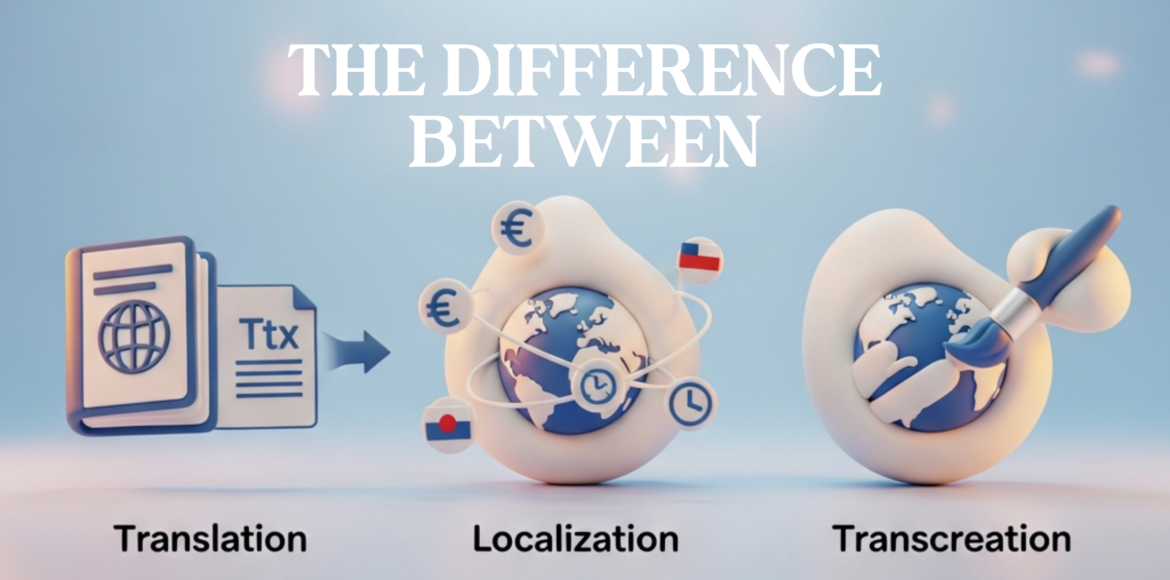
Translation is converting text from one language to another while keeping meaning intact. It focuses on accuracy, clarity, and fidelity to the source text.
- Best for: legal documents, technical manuals, user guides, academic articles.
- Goal: preserve meaning and technical accuracy.
- Example: Translating a product specification from English to Hindi—“dimensions: 50 x 30 cm” remains precise in Hindi.
Localization — adapting to local context and customs
Localization goes beyond words. It adapts content to match local culture, date/time formats, currency, images, and user expectations.
- Best for: websites, apps, e-commerce, games, customer support content.
- Goal: make the product feel native to target users.
- Example: An ecommerce site replacing “$” with “₹”, showing sizes in centimeters, and changing images to reflect local dress styles.
Transcreation — creative reimagining for emotional impact
Transcreation combines translation and creative writing. It recreates the same intent, tone, and emotional response rather than translating words verbatim.
- Best for: advertising, slogans, taglines, brand campaigns, social media posts.
- Goal: evoke the same reaction in the new audience.
- Example: A catchy English tagline like “Just Do It” requires a Hindi line that carries the same punch and brand tone, not a literal translation.
Why the difference matters — real stakes and examples
Practical stakes — when mistakes cost money and reputation
Choosing the wrong approach can lead to:
- Misunderstanding: Technical errors in user manuals can cause product misuse.
- Cultural offense: Poor localization can unintentionally insult local customs.
- Brand failure: Literal translations of slogans often fall flat or appear awkward.
- Lower conversions: A poorly localized checkout process reduces sales.
Real-world Hindi examples from my 6 years of work
During six years in translation across domains, I’ve encountered many cases where human judgment made the difference:
- Literal translation failure: An English marketing line “Our product sells like hotcakes” was translated word-for-word into Hindi. The phrase sounded strange and confusing. A transcreated line using a familiar cultural metaphor performed far better.
- Localization success: An app targeted to Mumbai users changed the greeting from “Good Morning” to include regional festivals and local time-sensitive content; engagement rose significantly.
- Legal translation accuracy: A software licence clause translated incorrectly led to user confusion about refunds. A human translator corrected the nuance and prevented disputes.
How to choose — decision framework
Quick checklist to decide between Translation, Localization, Transcreation
Use this checklist to decide what your content needs:
- Purpose: Is the content informational or persuasive?
- Informational → Translation
- Persuasive/marketing → Transcreation
- User expectation: Does the user expect local tailoring (currency, culture)?
- Yes → Localization
- Risk & accuracy needs: Is legal/technical accuracy critical?
- Yes → Translation (with domain expert review)
- Emotional intent: Do you need the same emotional resonance?
- Yes → Transcreation
Decision matrix (short)
- Technical/legal docs → Translation
- UI/E-commerce/apps → Localization
- Ads/marketing/slogans → Transcreation
- Mixed content (e.g., app + campaign) → Localization + Transcreation
Strategies & best practices for each approach
Best practices for Translation
- Use domain-expert translators (legal, medical, technical specialists).
- Maintain a glossary and style guide for consistent terminology.
- Implement quality assurance: peer review and back-translation where necessary.
- Use translation memory (TM) to save consistent phrases and reduce costs.
Best practices for Localization
- Conduct cultural research: festivals, taboos, idioms, imagery preferences.
- Replace visual content (images/icons) to match local norms.
- Localize UI/UX elements: date format, currency, text direction, contact formats.
- Test with real users in the target market (usability testing and A/B testing).
Best practices for Transcreation
- Brief the creative team: explain brand voice, campaign goals, and emotional triggers.
- Use copywriters fluent in the target language and culture.
- Provide the context: where the text appears, audience demographics, channel constraints.
- Create variants and test which resonates more with the audience.
Tools and workflows that combine all three
A hybrid workflow for modern projects
- Intake & analysis: classify content into translation/localization/transcreation buckets.
- Glossary & style setup: create central references for brand voice and legal terms.
- Assign specialists: translators for technical sections, localization engineers for product interfaces, transcreators for marketing.
- Integrate tools: use CAT tools, TMs, localization platforms, and CMS connectors.
- Quality checks: linguistic QA, functional QA, and in-market testing.
- Post-launch optimization: monitor metrics and iterate.
Example pipeline for a product launch in Hindi
- Phase 1: Translate legal and technical docs (Translation).
- Phase 2: Localize app strings, payment options, images (Localization).
- Phase 3: Transcreate ad campaigns and social captions (Transcreation).
- Phase 4: User testing in major Hindi-speaking regions and iterate.
Case studies and mini-examples
Case Study 1 — E-commerce checkout (Localization wins)
A global retailer localized currency and address fields for India. They also changed product images to reflect local dress and sizing. Result: 22% increase in completed checkouts from Hindi-speaking users.
Case Study 2 — Ad campaign (Transcreation wins)
An English slogan emphasizing “youthful rebellion” translated literally into Hindi sounded aggressive and off-brand. A transcreated Hindi line kept the playful spirit, used a regional metaphor, and increased click-through rates by 35%.
Case Study 3 — Legal document (Translation wins)
A SaaS company needed terms and conditions in multiple Indian languages. Accurate, domain-specific translation avoided legal disputes and improved user trust.
Tips for working with translators and agencies
What to ask before hiring
- Do they have experience with Hindi and other Indian languages?
- Can they show domain-specific samples (legal, technical, marketing)?
- Do they provide localization engineering (string extraction, placeholders)?
- What is their quality assurance process (proofreading, back-translation)?
How to brief for better outcomes
- Provide the context: where the text will appear.
- Share brand voice and examples of tone.
- Give target audience demographics and cultural notes.
- Supply visual references if relevant.
- Set clear KPIs: time-to-market, conversion goals, readability scores.
Common pitfalls and how to avoid them
Pitfalls
- Overreliance on machine translation for creative copy.
- Ignoring regional variations within the same language (e.g., Hindi dialects).
- Treating localization as a one-time task rather than an ongoing process.
- Not testing with real users in the target market.
Remedies
- Use human editors for marketing content.
- Build locale-specific style guides (Hindi-India, Hindi-UP, etc.).
- Keep localization in the product lifecycle—update regularly.
- Run small pilots before big-rollouts.
Why Text & Arts Solutions is the partner you need
Text & Arts Solutions brings together experienced translators, cultural consultants, and creative transcreators to deliver results that speak to your audience—literally and emotionally. Here’s how we help:
- End-to-end services: translation for accuracy, localization for usability, transcreation for brand impact.
- Hindi and Indian languages expertise: after six years in the field, our team knows the nuances that machines miss—regional idioms, festival references, and tone suited to local audiences.
- Domain specialists: legal, medical, technical, and marketing translators who understand industry jargon.
- Localization engineering: string management, CMS integration, and QA testing.
- Creative transcreation team: copywriters who craft culturally resonant taglines, social posts, and ad copy.
- Pilot testing & analytics: we test with real users and optimize based on performance metrics.
Ready to translate beyond words? Contact Text & Arts Solutions for a free content audit. We’ll classify your content, recommend the right mix of Translation, Localization, Transcreation, and give you a roadmap to better engagement and conversions.
Conclusion:
Understanding the difference between Translation, Localization, Transcreation is not academic—it’s strategic. Translation preserves meaning and accuracy, localization tailors product and experience to a culture, and transcreation preserves emotional intent and brand voice. Especially for Hindi and other Indian languages, the human touch matters: idioms, register, and cultural references can’t always be automated. Use the decision checklist and workflows in this guide to choose the right approach. And if you want content that converts in local markets—reach out to Text & Arts Solutions. We blend technical precision with cultural creativity so your message resonates, everywhere it needs to.